Street View, live performance and video, Terme di Caracalla, Rome, IT, 2013.
Eco, live performance and video, location: Museum Terrace, MADRE Naples. Production Museo Madre - Museo d’Arte Contemporanea Donna Regina, 2012.
Street View, live performance and video, Terme di Caracalla, Rome, IT, 2013.
Eco, live performance and video, location: Museum Terrace, MADRE Naples. Production Museo Madre - Museo d’Arte Contemporanea Donna Regina, 2012.
Street View I 2013
live performance, duration: 2 hours; video, 7 min 34 sec, sound, color. Location: Terme di Caracalla, Rome, IT
Street View is a happening that takes place within traffic, along the road running alongside the fence of the Baths of Caracalla in Rome (Italy). The artist waits at the traffic light, as if he were a windshield washer or a street vendor, until the signal allows him to weave between the cars to leaf through books on natural landscapes, marine creatures, and animal species. Fleeting images flow over the car window, transforming the driver into a spectator—intrigued, disturbed, indifferent, or distracted—confronted by an “out of place” action that is not immediately understandable, evoking an “extraurban” elsewhere. Street View establishes a direct relationship between the artwork and its viewer, prompting reflection on the concepts of origin, identity, travel, vision, and extinction.
Eco I 2012
live performance, duration: 8 hours; video, duration: 7 min 34 sec; sound, color, 16:9; produced by Museo MADRE – Museo d’Arte Contemporanea Donnaregina, Naples
Visible from the street and neighboring terraces, the artist sits all day on the ledge of the museum’s roof terrace, like a modern stylite. Chironi observes Mount Vesuvius with a book on the Dolomites under his arm. He wears civilian clothes alongside climbing gear that is seemingly out of context. Acting as a metropolitan climber, the artist builds a personal, empathetic connection with the area immediately surrounding the museum and with the city itself. The performance is a long-duration action whose climax features Chironi shouting at specific intervals. The echo of this shout—resembling the echo that spreads through mountain valleys, reinforced by a powerful sound system—aims to reach the entire city as well as the inner rooms of the museum, establishing a primal, imaginary dialogue with the surrounding urban fabric, as well as an ironic, ideal bridge between Southern and Northern Italy, from Vesuvius to the Dolomites.
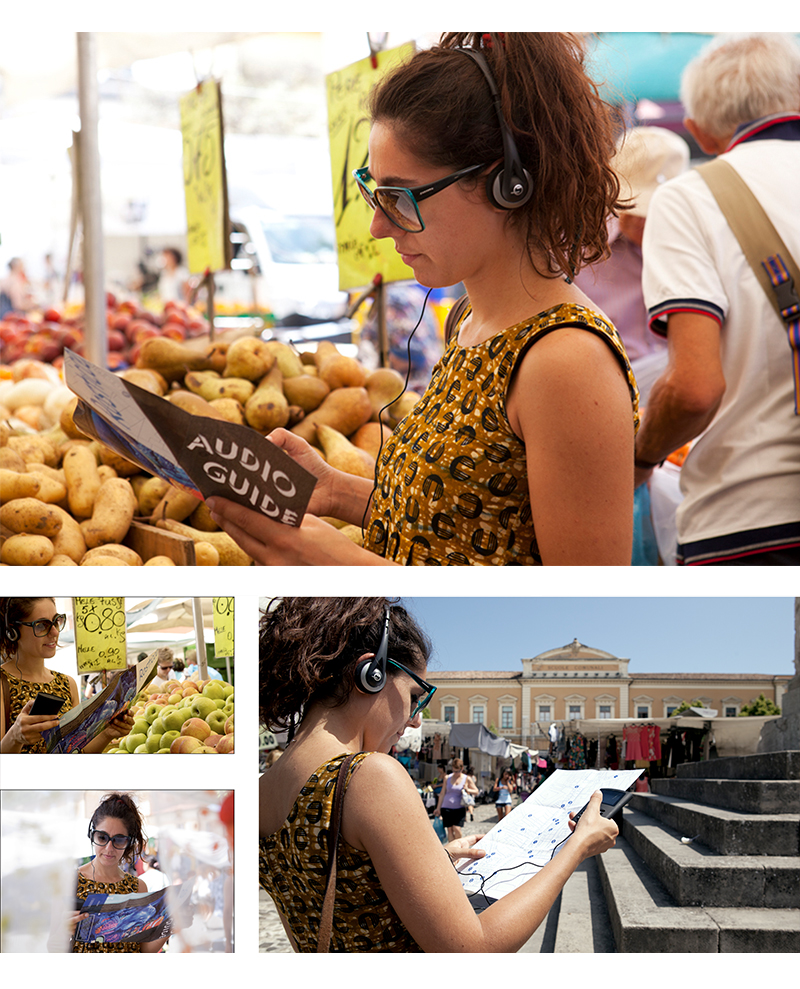
Audio Guide | 2014
Relational art, variable durations
The market is a site where desires and needs are negotiated; a specific visual and auditory language enables their expression. The public is guided through a staged itinerary within a spread-out museum (museo diffuso) that subverts market dynamics, generating short circuits between images and sounds while relocating them elsewhere. This crisis of the senses intersects transversely with the crisis of the commercial economy, suggesting potential ways out. Each individual’s imagination is called upon to compose and mediate the playful, poetic route shaped by the narrator’s voice. The journey evokes fantasies bound to the animal world, individual and collective myths, as well as affinities between different semiotic systems. The artist develops a concept of immaterial property that runs parallel to market logic, drawing upon the arrangement of the stalls (or their absence) and the evocative power of objects and conversations. Audio Guide is a project designed for the Marché de la Libération (Nice), the Piazza Seminario market in Cuneo, the Piazza Ganganelli market in Santarcangelo di Romagna, and the Via Quirra Market in Cagliari.
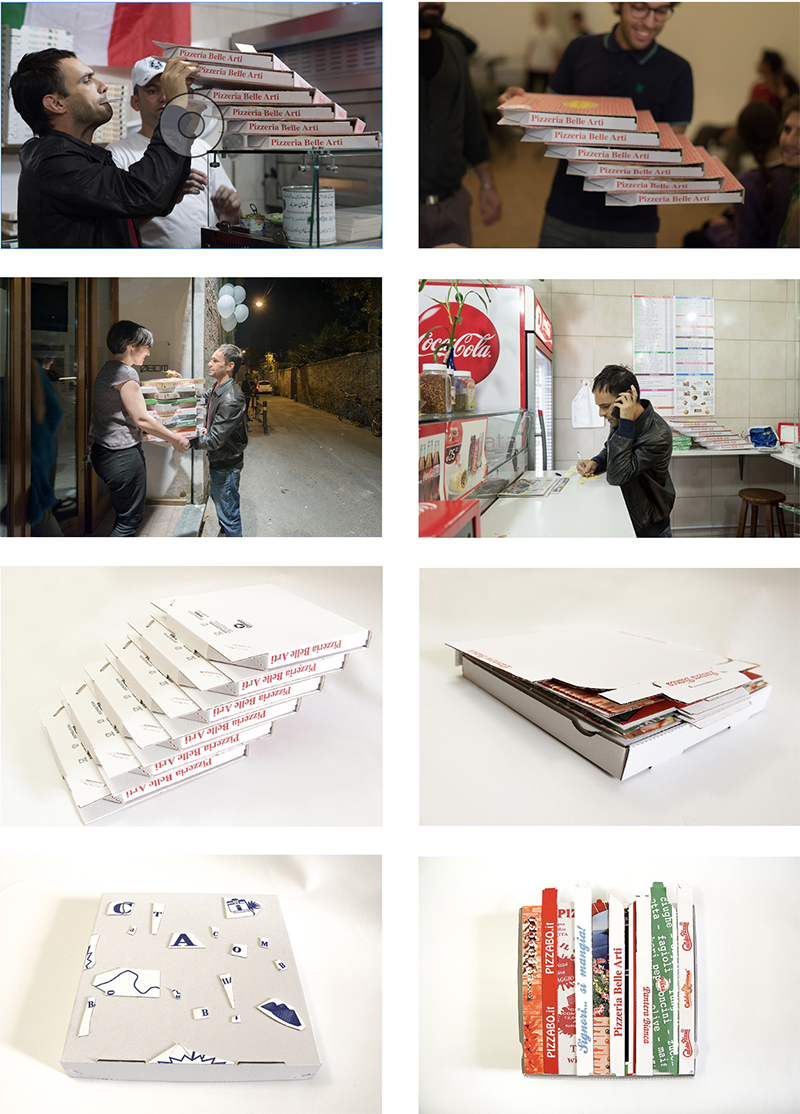
Take Away | 2014
live performance, Xing/Raum, Bologna
Through an intervention, a sign, or a phrase, the home delivery of a pizza is transformed into an act aimed at shifting a mental and emotional state—like a push or a lift that transports one to another position, beyond routine gestures. In collaboration with: Pizzeria & Kebab Nosadella Take Away
↓ scroll down
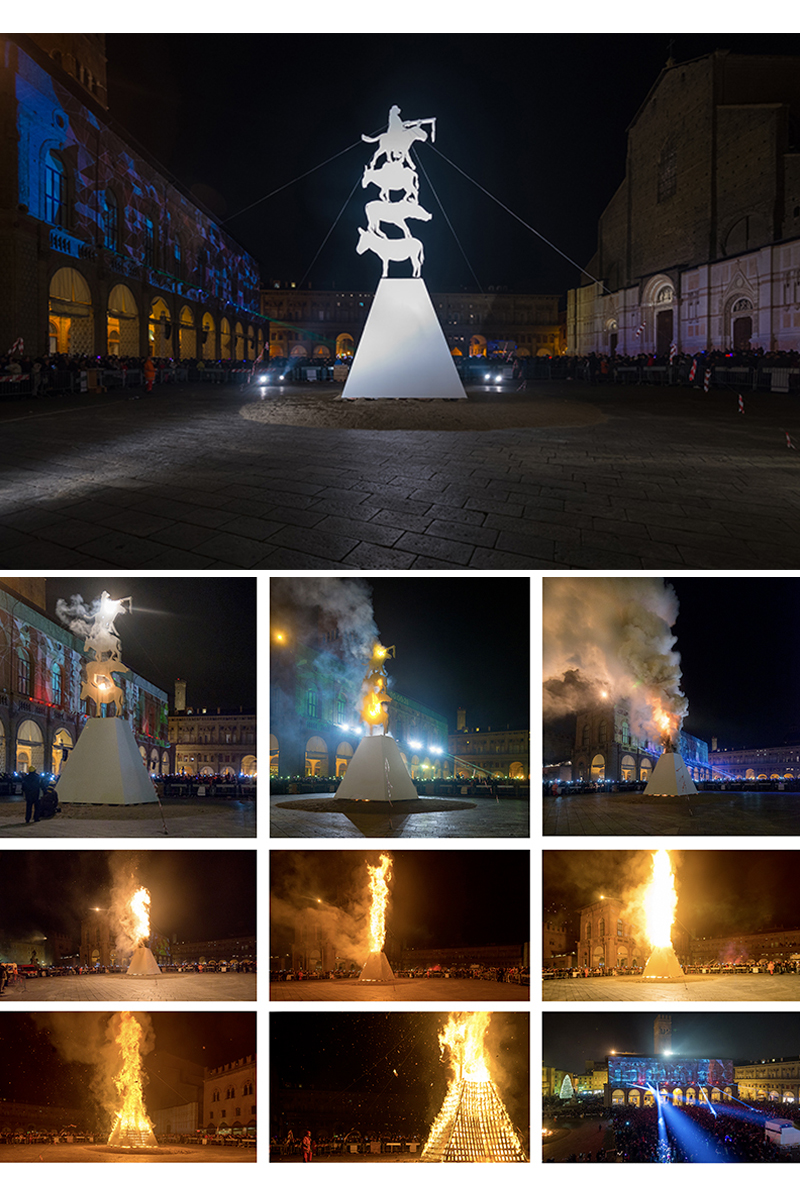
Donkey Tower | 2015
The city of Bologna celebrates the arrival of the new year in its main square with the burning of a giant puppet symbolising the year gone by (the so-called “Vecchione”), traditionally designed by artists with ties to the city.The Donkeys Tower is a negative cutout, a wooden outline about 10 metres high. It features a base similar to those of the other towers in Bologna (including the famous Asinelli Tower), topped with four donkeys stacked on top of one another: the first is standing still, the second is being pulled by a rope, the third is carrying heavy loads, and the one at the very top is ridden by an old man using the carrot-and-stick approach.The Donkeys Tower is a symbol of obstinacy, stubbornness, dullness, and submission: four traits that have always been (wrongly) attributed to donkeys and are even more negative when ascribed to human beings. The burning of the Donkeys Tower is a symbolic act to shed these negative characteristics and become, in the coming year, a little less “donkeys”.
↓ scroll down