Supercar, artist's light, permanent, MAUTO National Automobile Museum, 2024, Turin.
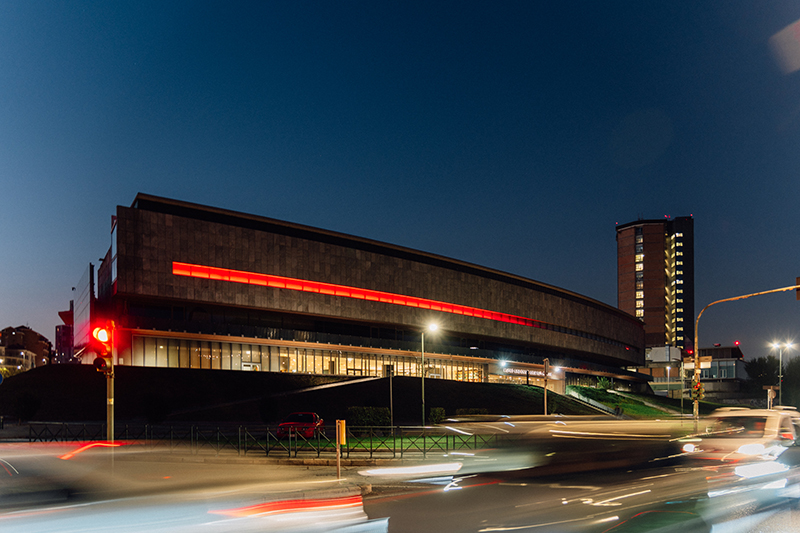


Supercar, artist's light, permanent, MAUTO National Automobile Museum, 2024, Turin.
SUPERCAR I 2024
artist’s light, permanent, MAUTO National Automobile Museum, Turin
Supercar is the title of the light installation that combines light, architecture, cars, science fiction, customisation, movement and the collective imagination. The first immediate reference is Supercar, the 1980s television series in which the undisputed protagonist is a car characterised by futuristic technology called K.I.T.T. (Knight Industries Two Thousand): equipped with artificial intelligence – which makes it think – and capable of feeling and experiencing states of mind, K.I.T.T. is a car – in the first series it was a 1982 Pontiac Firebird Trans Am – whose distinctive feature is the light scanner placed on the grille that allows it to see its surroundings thanks to infrared. On a second level of interpretation, this explicit reference to popular culture and collective memory gives way to a relationship with the more contemporary concept of the ‘supercar’, i.e. the automobile sapiens capable of interacting with the user and the context, processing information, learning and acting autonomously in ways and criteria similar to those of human beings.
Cristian Chironi intervened on the façade of the building in Corso Unità d’Italia, imagined as the front of a car: the windows overlooking the balcony house a light scanner that moves along a horizontal line, bringing the architecture into a new space-time context.
W (STEP STOP Pierre Jeanneret Museum Chandigarh) I 2019
artist’s light, permanent, Esprit Nouveau Pavilion, Bologna
In conjunction with Bologna Drive, the project by Cristian Chironi is focused on the relationship between the Emilian city and the modernist architect Le Corbusier. It has been conceived in the frame of Oplà. Performing Activities at Arte Fiera 2019. In collaboration with Xing cultural association, the artist installed a public artwork as a tribute to Kinkaleri’s imaginary wetropolitan line. The luminous signal, an inverted M for underground, is further transformed by Chironi into a stylized staircase, inspired by the external motifs of the Chandigarh villa designed by Pierre Jeanneret and located near the entrance to the fair, in front of the Esprit Nouveau pavilion, originally built by Le Corbusier in Paris in 1925, and reconstructed in Bologna in 1977 by initiative of Ente Fiera and the Municipality of Bologna.
Follow the construction of the subway line of inversion on the blog wetropolitan.blogspot.com